
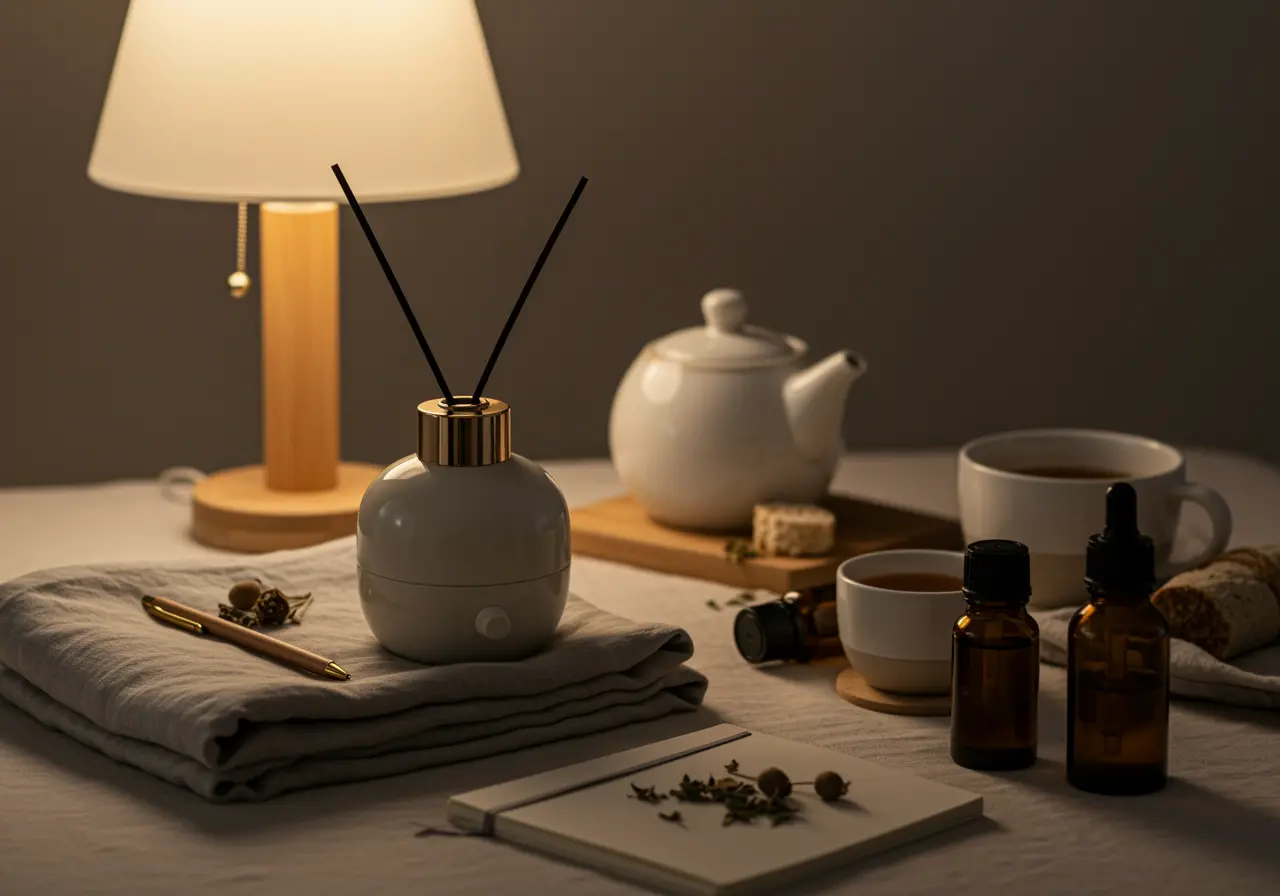
Why most evening scent routines fail
Most evening scent advice starts too far from real life. It assumes a calm bedroom, a predictable schedule, and one obvious aromatic goal. Real homes are messier than that. Some people spend their last hour in the living room, some in the kitchen finishing the day, some moving between bathroom, hallway, and bedside in short bursts. A routine only works if it respects that actual map.
That is why a personal evening scent routine should not begin with a pretty blend recipe. It should begin with the lived shape of the home: where the last hour happens, what noise or light is still present, how many people share the space, and whether the goal is soft decompression, emotional separation from work, or simply making the home feel quieter before sleep.
Start with the part of the home that holds the last hour
Instead of asking “What oils are relaxing?”, ask “Where does my evening actually slow down?” In some homes the last hour happens beside a sofa, in others at a desk being closed for the night, and in others only once the bedroom door is shut. The anchor room matters because scent lingers in space differently than it lingers in memory. A beautiful oil in the wrong room can feel random rather than supportive.
The easiest mistake is trying to spread one identical evening profile everywhere. Diffusing the same blend in a bathroom, bedroom, and open-plan living area can flatten the whole atmosphere. It is often better to choose one primary zone and let the rest of the house stay quieter.
Choose one evening job for scent
Good evening scent routines usually do one job clearly. They help a room feel softer after bright daytime momentum, mark the boundary between work and rest, or make a bedtime space feel more private and less exposed. Problems begin when one routine tries to be calming, clarifying, luxurious, comforting, and sleep-inducing all at once.
For most readers, the cleanest starting point is to choose one of three directions: soften, ground, or clear. Soften is for people who carry stimulation too late into the night. Ground is for people who want the room to feel lower, steadier, and more held. Clear is for evenings that need emotional reset rather than coziness.
Public starting principles
Make one room do the work
A personal routine is easier to feel when one area clearly carries it. A focused evening zone works better than weak scent scattered through the whole home.
Use fewer drops than daytime
Evening routines usually benefit from lower aromatic volume. The goal is not to fill the room aggressively, but to let the atmosphere shift almost in the background.
Keep the scent message simple
One clear emotional direction lands better at night than a complicated blend trying to express five ideas at the same time.
Let the room calm before you do
Often the strongest routines start 20 to 40 minutes before the person fully arrives in wind-down mode, so the space is already gentler when they enter it.
Premium membership coming soon
The rest of this article will open when premium membership goes live.
Premium membership is still in launch prep. If you want to be first to know when subscriptions open, join the newsletter and we will let you know when this layer becomes available.