
Basil Essential Oil
Essential Oils
Basil essential oil is bright, green, sweet, and herbaceous: a familiar kitchen-garden aroma transformed into a concentrated aromatic oil with a crisp, lively personality.
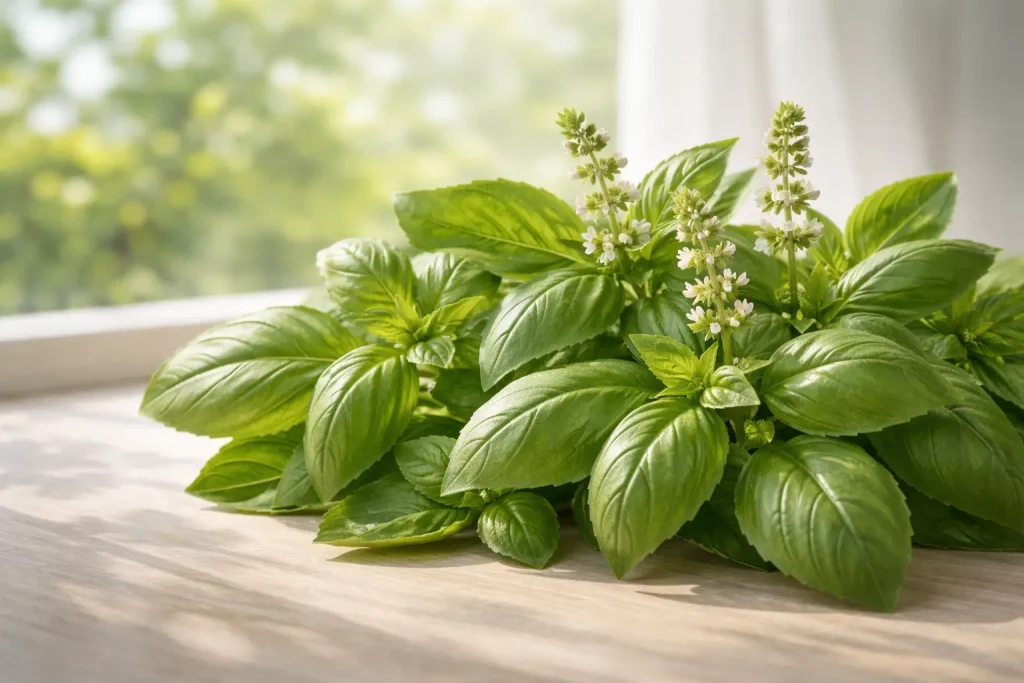
Steam distilled from the leaves and flowering tops of Ocimum basilicum, Basil essential oil is often used in diffuser blends, fresh herbal accords, natural perfumery, and carefully diluted body-care formulas. It can feel clear and uplifting in a room, especially when paired with citrus, mint, soft florals, or other Mediterranean herbs. Because basil oils vary widely in chemistry, this is also an oil where chemotype, dilution, and safety notes matter.
Quick Answer
Basil essential oil is a sweet, green, herbal oil from Ocimum basilicum. It is commonly chosen for fresh diffuser blends, herbal natural perfumes, study or work atmospheres, and low-dilution topical blends when appropriate. Basil essential oils can vary from linalool-rich to estragole or methyl eugenol-rich types, so use modestly, avoid casual ingestion, and check safety guidance carefully before topical use.
What Is Basil Essential Oil?
Basil essential oil comes from Ocimum basilicum, an aromatic herb in the mint family, Lamiaceae. The plant is famous as a culinary herb, especially in Mediterranean and Asian cooking, but the essential oil is much more concentrated than fresh basil leaves and should not be treated like a kitchen ingredient.
The oil is typically produced by steam distilling the leaves and flowering tops. Depending on the cultivar, region, harvest time, and distillation conditions, Basil essential oil can have very different chemical profiles. Some oils are rich in linalool and smell soft, sweet, and herbaceous. Others contain higher levels of methyl chavicol, also called estragole, or methyl eugenol, which changes both the aroma and the safety considerations.
In aromatherapy, Basil essential oil is often chosen when a blend needs a vivid green lift. It can make citrus oils feel more botanical, soften sharper herbs, and add a garden-fresh top note to natural perfume blends.
Basil Essential Oil Types and Chemotypes
The name “Basil essential oil” can hide important differences. The most common aromatherapy material is usually described as sweet basil or linalool-rich basil, but not every bottle has the same chemistry. Published studies on Ocimum basilicum show oils dominated by linalool in some samples and methyl chavicol or methyl eugenol in others.
A linalool-rich Basil essential oil tends to smell soft, sweet, green, and slightly floral. This is often the type preferred for gentle-feeling aromatherapy blending, though it still needs dilution and moderation.
Methyl chavicol-rich Basil essential oil smells more anise-like, sweet, sharp, and spicy. This type requires more caution, especially for topical use, because estragole is a restricted constituent in essential oil safety discussions. Methyl eugenol-rich oils also require careful restriction. If the chemotype is unknown, use Basil essential oil very sparingly and avoid topical use unless you have reliable batch information and appropriate guidance.
Basil essential oil is also different from Holy Basil Essential Oil, which comes from Ocimum tenuiflorum, and from Thai basil materials, which are associated with particular culinary varieties of Ocimum basilicum. These plants are related, but their aromatic profiles and safety considerations are not identical.
What Does Basil Essential Oil Smell Like?
Basil essential oil smells green, sweet, herbal, and lively. A linalool-rich oil can have a soft floral edge, while an estragole-rich oil may smell more like anise, licorice, or tarragon. Some basil oils also carry peppery, clove-like, or lightly camphoraceous facets.
The overall impression is fresh and garden-like. It can remind people of crushed basil leaves, warm greenhouse air, herb stems, and bright kitchen herbs. In blends, Basil essential oil is noticeable even in small amounts, so it is usually best used as an accent rather than the main voice.
Common Uses of Basil Essential Oil
Basil essential oil is commonly used in diffuser blends when a clear, green, herbaceous atmosphere is wanted. It pairs especially well with citrus oils such as Lemon Essential Oil, Lime Essential Oil, Bergamot Essential Oil, and Sweet Orange Essential Oil.
It is also used in study, planning, or work routines because its aroma feels bright and attentive. This is best understood as an aromatic atmosphere choice, not a medical effect. A few drops in a well-balanced diffuser blend can help a room feel fresher while you read, tidy, plan, or reset your space.
In natural perfumery, Basil essential oil can add a green herbal top note. It works well in Mediterranean-style blends with Rosemary Essential Oil, Sweet Marjoram Essential Oil, and Thyme Linalool Essential Oil, or in softer compositions with Lavender Essential Oil, Neroli Essential Oil, and Petitgrain Essential Oil.
For topical use, Basil essential oil should be approached carefully. Linalool-rich basil may be suitable at low dilution for some adult body-care blends, but estragole-rich and methyl eugenol-rich oils need stricter limits. When in doubt, keep Basil essential oil for diffusion or ask a qualified aromatherapy professional for batch-specific guidance.
Quick Tips for Using Basil Essential Oil
Check the Chemotype
Look for batch details or GC/MS information when possible. Basil oils can vary widely, and chemistry affects safe use.
Use Tiny Amounts
Basil is vivid and can dominate a blend. Start with 1 drop, especially in diffuser and perfume recipes.
Avoid Casual Internal Use
Fresh basil leaves are food; Basil essential oil is a concentrated aromatic extract. Do not ingest it casually.
Dilution Guidance
Dilution guidance for Basil essential oil depends strongly on the oil’s chemistry. A linalool-rich Basil essential oil is generally approached more gently than an estragole-rich or methyl eugenol-rich basil oil, but all basil oils should still be diluted before skin use.
For adult topical use with a known linalool-rich Basil essential oil, a conservative range is about 0.25% to 0.5% for leave-on body products. This means roughly 1 drop of essential oil in 4 to 8 teaspoons, or 20 to 40 ml, of carrier oil. For sensitive skin, use less or avoid topical use.
If the Basil essential oil is rich in methyl chavicol, also called estragole, or if the chemotype is unknown, avoid topical use unless you have reliable safety guidance. Tisserand Institute notes that estragole-rich basil oil requires very low maximum topical use. This is one of the clearest examples of why the botanical name alone is not enough.
Simple Dilution Reminder
Do not apply Basil essential oil undiluted. If you do not know whether your oil is linalool-rich, estragole-rich, or methyl eugenol-rich, use it only very sparingly in diffusion or consult a qualified professional before using it on skin.
How to Use Basil Essential Oil
For diffusion, add 1 drop of Basil essential oil to a blend with citrus, lavender, mint, or gentle herbs. Diffuse in a well-ventilated room for short sessions rather than continuously. Basil can become strong quickly, so it is usually better as an accent.
For a fresh study or desk blend, combine Basil essential oil with Lemon Essential Oil and Rosemary Essential Oil. The result is green, crisp, and botanical without needing a large amount of oil.
For natural perfumery, use Basil essential oil in trace amounts as a top note. It can make a blend feel alive and leafy when paired with Bergamot Essential Oil, Neroli Essential Oil, Clary Sage Essential Oil, or Frankincense Essential Oil.
For topical use, only use Basil essential oil when the chemistry is appropriate and the dilution is low. Avoid the face, eyes, mucous membranes, broken skin, and sensitive areas. Do not use Basil essential oil in bathwater without proper dispersal, because oil droplets can cling to the skin and irritate.

History and Origins of Basil
Basil has been grown and used for centuries as a culinary, aromatic, and symbolic herb. Plants of the World Online lists Ocimum basilicum as native across tropical and subtropical Asia to northern Australia, and today basil is cultivated in many warm regions around the world.
As a kitchen herb, basil is inseparable from pesto, summer tomatoes, herb gardens, and fragrant sauces. It is also important in Asian cuisines, where different basil types bring sweet, spicy, lemony, or anise-like notes to food. These culinary traditions involve the fresh or dried herb, not casual use of the essential oil.
The essential oil became valuable in perfumery, flavor research, and aromatic blending because basil contains volatile compounds with a powerful fragrance. Modern analysis shows that basil oils can be chemically diverse, which helps explain why one Basil essential oil may smell soft and floral while another smells more spicy, anise-like, or sharp.
Diffuser Blends with Basil Essential Oil
Garden Window
- 1 drop Basil Essential Oil
- 3 drops Lemon Essential Oil
- 1 drop Lavender Essential Oil
A bright, green blend with a soft herbal edge and a clean morning feel.
Herb Market
- 1 drop Basil Essential Oil
- 2 drops Bergamot Essential Oil
- 1 drop Rosemary Essential Oil
Crisp, herbal, and citrus-green, like walking past fresh herbs in warm air.
Soft Green Reset
- 1 drop Basil Essential Oil
- 2 drops Sweet Orange Essential Oil
- 1 drop Petitgrain Essential Oil
Fresh, leafy, and lightly sweet, with a relaxed citrus-herbal character.

What Blends Well with Basil Essential Oil?
Basil essential oil blends especially well with citrus oils such as Lemon Essential Oil, Lime Essential Oil, Bergamot Essential Oil, Sweet Orange Essential Oil, Pink Grapefruit Essential Oil, and Red Mandarin Essential Oil. Citrus keeps basil feeling bright and fresh.
It also pairs naturally with other green and herbal oils, including Rosemary Essential Oil, Spearmint Essential Oil, Sweet Marjoram Essential Oil, Thyme Linalool Essential Oil, and Clary Sage Essential Oil. These combinations can smell like a warm herb garden, though they should be balanced carefully because herbal oils can become intense.
For softer aromatic blends, try Basil essential oil with Lavender Essential Oil, Roman Chamomile Essential Oil, Neroli Essential Oil, or Geranium Essential Oil. For grounding, use a tiny amount with Cedarwood Atlas Essential Oil, Frankincense Essential Oil, or Sandalwood Essential Oil.
Basil Essential Oil FAQ
Is Basil essential oil the same as fresh basil?
No. Fresh basil is a culinary herb, while Basil essential oil is a concentrated aromatic extract. The essential oil should be used by the drop, diluted for skin use, and not ingested casually.
What is Basil essential oil commonly used for?
It is commonly used in fresh diffuser blends, green herbal perfumes, study or work atmospheres, and carefully diluted adult body-care blends when the chemotype and safety profile are appropriate.
What does Basil essential oil smell like?
It smells green, sweet, herbal, and slightly spicy. Some basil oils smell soft and floral because of linalool, while others smell more anise-like because of methyl chavicol, also called estragole.
Is Basil essential oil safe on skin?
It depends on the chemotype, dilution, and user. Linalool-rich basil may be used at low dilution by some adults, but estragole-rich or methyl eugenol-rich basil oils require stricter limits. If the chemotype is unknown, avoid topical use or consult a qualified professional.
Can Basil essential oil be used around children or pets?
Use extra caution. Diffuse only lightly in a ventilated room, keep oils out of reach, and avoid using Basil essential oil around babies, young children, pets, pregnant people, or sensitive individuals without qualified guidance.

Basil Essential Oil, Spirituality, and Soul
The main sections above focus on botanical information, practical use, dilution, and safety. Basil also has a symbolic and spiritual life in modern aromatherapy, shaped by its long association with gardens, kitchens, warmth, and green vitality.
In symbolic routines, Basil essential oil may be used to mark a return to clarity. Its scent can feel like opening a window in the mind: fresh, bright, and practical. This makes it a natural choice for simple rituals around planning, tidying, journaling, or beginning focused work.
Basil can also symbolize nourishment and protection in a very ordinary, grounded sense. It is a plant of the table, the garden, and the hands. Used aromatically and with care, it can support a personal atmosphere of freshness and intention without making hard claims about emotional or spiritual outcomes.
Safety Notes
Basil essential oil requires careful use because different chemotypes can have different safety profiles. Dilute before topical use, avoid eyes, mucous membranes, broken skin, and sensitive areas, and do not ingest casually.
Use Basil essential oil moderately in a well-ventilated room. Avoid continuous diffusion, especially around babies, young children, pregnant or breastfeeding people, pets, older adults, and anyone with asthma, migraines, allergies, respiratory sensitivity, or strong scent sensitivity.
Topical use should be conservative. If your Basil essential oil is linalool-rich and appropriate for skin use, keep dilution low. If it is estragole-rich, methyl eugenol-rich, or chemically unknown, avoid topical use unless guided by a qualified professional. Do not use Basil essential oil during pregnancy or breastfeeding without professional guidance.
Stop using the oil if irritation, redness, itching, headache, nausea, coughing, wheezing, dizziness, or any other adverse reaction occurs. Keep essential oils away from children and pets, and do not use them as a substitute for medical care.
Safety-first reminder: Basil essential oil can be a beautiful green accent, but it is not a casual kitchen ingredient. The safest approach is to use very small amounts, check chemotype information when possible, and keep topical use conservative.
Further Reading and Sources
For botanical, chemical, and safety-oriented background, these sources may be useful starting points:
- Kew Plants of the World Online: Ocimum basilicum L.
- Royal Horticultural Society: Ocimum basilicum
- Chemical Diversity in Basil (Ocimum sp.) Germplasm
- Chemical Composition and Antifungal Activity of Ocimum basilicum L. Essential Oil
- Chemical Composition and Antimicrobial Activity of the Essential Oil of Ocimum basilicum L.
- Tisserand Institute: Carcinogenic Essential Oils?
- Tisserand Institute: Q&A Safety Maximums for Dermal Application