
Rosemary Essential Oil
Essential Oils

Rosemary essential oil is a fresh, herbal, camphoraceous essential oil steam distilled from the aromatic leaves and flowering tops of rosemary. Its current botanical name is Salvia rosmarinus, though many labels and older references still use the former name Rosmarinus officinalis.
Rosemary essential oil is often used in focus-friendly diffuser blends, scalp and hair-care products, massage oils, fresh home fragrance, shower products, and herbaceous DIY recipes. It has a strong, clear, stimulating aroma, so it should be used thoughtfully, especially around children, pregnancy, nursing, epilepsy, seizure disorders, high blood pressure concerns, asthma, respiratory sensitivity, and sensitive skin.
Quick Answer
Rosemary essential oil is a concentrated herbal oil from Salvia rosmarinus, formerly known as Rosmarinus officinalis. It has a fresh, strong, herbal, camphoraceous aroma and is commonly used in diffuser blends, scalp-care products, massage oils, shower products, and focus-friendly daytime routines. It should be diluted before skin use and used with extra caution around children, pregnancy, nursing, epilepsy, seizure disorders, asthma, and sensitive skin.
What Is Rosemary Essential Oil?
Rosemary essential oil is steam distilled from the leaves and flowering tops of Salvia rosmarinus. The plant was historically known as Rosmarinus officinalis, and that older name is still common on essential oil labels, aromatherapy books, and product pages. Both names refer to rosemary, but the current botanical placement is within the Salvia genus.
Rosemary belongs to the mint family, Lamiaceae. This connects it botanically with lavender, peppermint, spearmint, basil, sage, thyme, oregano, marjoram, clary sage, spanish sage, and melissa.
The oil is usually rich in aromatic compounds such as 1,8-cineole, camphor, alpha-pinene, borneol, and related constituents, though the exact composition can vary by origin, growing conditions, harvest timing, distillation, and chemotype. This is one reason rosemary oils can smell slightly different from one bottle to another.
Rosemary essential oil is not the same thing as fresh rosemary, dried rosemary, rosemary tea, rosemary extract, rosemary hydrosol, or culinary rosemary. The essential oil is much more concentrated and should be handled with essential oil safety in mind.
Rosemary Chemotypes and Why They Matter
Rosemary essential oil is often discussed by chemotype. A chemotype is a chemically distinct profile within the same botanical species. In practical terms, two oils may both come from Salvia rosmarinus, but one may be more cineole-rich, another more camphor-rich, and another more verbenone-influenced.
Common rosemary chemotype language includes rosemary ct. cineole, rosemary ct. camphor, and rosemary ct. verbenone. These are not different species, but they can differ in aroma, practical use, and safety nuance.
A cineole-rich rosemary oil can feel fresh, clear, and eucalyptus-like, placing it near oils such as eucalyptus radiata, ravintsara, cajeput, and niaouli. A camphor-rich rosemary oil may feel sharper, stronger, and more stimulating. A verbenone-type rosemary may smell softer and is often discussed in skin-care contexts, though it still needs careful dilution.
When writing or formulating seriously, “rosemary essential oil” is not always enough information. The best labels provide the botanical name, plant part, extraction method, country of origin, and ideally a GC/MS report or chemotype information.
Rosemary Plant History and Traditional Use
Rosemary is native to the Mediterranean region and has been valued for centuries as a culinary herb, fragrant garden shrub, symbolic plant, and traditional household herb. It grows well in sunny, dry, rocky, coastal environments, and its name has often been linked with the Latin words for “dew” and “sea,” giving rise to the poetic idea of rosemary as “dew of the sea.”

In ancient Greek and Roman traditions, rosemary was associated with memory, study, remembrance, and ritual. Students were sometimes said to wear rosemary garlands, and the plant became connected with mental clarity and recall. It was also used in cooking, household scenting, ceremonies, and seasonal traditions.
In medieval and early modern Europe, rosemary appeared in herb gardens, kitchens, wedding customs, funeral traditions, and protective household practices. It was valued as a plant of remembrance and continuity: something carried, worn, burned, grown, cooked with, and placed in meaningful spaces.
These historical uses belong to the rosemary plant itself, not automatically to modern concentrated rosemary essential oil. Fresh rosemary sprigs, dried rosemary, herbal infusions, culinary use, incense-like burning, and essential oil are different preparations with different strengths and safety considerations.
What Does Rosemary Essential Oil Smell Like?
Rosemary essential oil smells fresh, herbal, woody, camphoraceous, green, and slightly sharp. It has a clear, awake quality that can make a blend feel more focused and structured.
Compared with lavender, rosemary is stronger, greener, and less floral. Compared with peppermint, it is less minty and less cooling, but still bright and stimulating. Compared with eucalyptus radiata, rosemary can feel more herb-garden-like and less purely airy.
Rosemary blends well with lemon, sweet orange, bergamot, peppermint, eucalyptus radiata, tea tree, lavender, cedarwood atlas, frankincense, black spruce, basil, clary sage, and juniper berry.
Common Uses of Rosemary Essential Oil
Rosemary essential oil is often chosen when a blend needs to feel focused, herbal, fresh, stimulating, clear, or structured. It is common in diffuser blends, scalp-care products, massage oils, shower products, fresh home fragrance, study routines, and herbaceous DIY recipes.
Because rosemary has a strong reputation for memory, hair, and stimulation, it is important to keep claims careful. It can support a focus-friendly atmosphere or be part of a scalp-care routine, but it should not be presented as a guaranteed treatment for memory problems, hair loss, pain, circulation issues, or medical conditions.
Focus-Friendly Diffuser Routines
Rosemary is often used in daytime diffuser blends for work, study, reading, planning, and mental reset routines. Its aroma feels bright and organized, especially when paired with citrus or mint.
Good focus-style partners include lemon, peppermint, eucalyptus radiata, basil, black spruce, and frankincense. Use rosemary lightly in small rooms, because the aroma can become intense or sharp.

Scalp and Hair-Care Products
Rosemary essential oil is widely used in scalp oils, shampoos, conditioners, scalp massage blends, and hair-care products. It gives formulas a fresh, herbal scent and pairs naturally with peppermint, tea tree, cedarwood atlas, lavender, clary sage, and geranium rose.
Some research has explored rosemary oil in hair-related contexts, but home use should stay cautious. Do not claim that rosemary essential oil regrows hair or treats hair loss. It is better to describe it as a popular aromatic ingredient in scalp-care routines and hair-care products.
For scalp use, dilution matters. Essential oils can irritate the scalp if used too strongly, especially with frequent application or sensitive skin. Keep blends away from the eyes and stop using them if burning, itching, redness, flaking, or discomfort occurs.
Massage and Post-Activity Blends
Rosemary is often used in adult massage blends when a formula needs an active, herbal, warming-clear character. It pairs well with black pepper, ginger, cedarwood atlas, frankincense, juniper berry, sweet orange, and lavender.
This does not mean rosemary essential oil treats pain, injuries, circulation problems, or inflammation. For massage, it should be presented as an aromatic ingredient that can support a fresh, invigorating body-care routine.
Shower and Morning Products
Rosemary works well in shower products because steam can carry its herbaceous aroma quickly. It can make a morning shower feel fresh and awake, especially with lemon, peppermint, eucalyptus radiata, or black spruce.
Steam can also make rosemary feel stronger. Avoid getting rosemary essential oil near the eyes or face in shower routines, and do not place neat essential oil directly where it can contact bare skin undiluted.
Fresh Home Fragrance
Rosemary can give home fragrance blends a clean, herbal structure. It is less sweet than citrus and less medicinal than tea tree, which makes it useful in fresh room sprays and diffuser blends.
It pairs naturally with lemon, sweet orange, bergamot, lavender, eucalyptus radiata, tea tree, black spruce, cedarwood atlas, and frankincense. In home sprays, use caution around children, pets, food surfaces, polished wood, delicate fabrics, and poorly ventilated rooms.
Herbal Perfumery and Natural Blending
In natural perfumery, rosemary can add green lift and aromatic structure. It works well in Mediterranean herb blends, fresh cologne-style blends, green citrus blends, and forest-herbal compositions.
Use small amounts. Rosemary can overpower delicate florals such as roman chamomile, rose, or neroli if the blend is not balanced carefully.
Quick Tips for Using Rosemary Essential Oil
Clear Desk Blend
Add 2 drops rosemary, 3 drops lemon, and 1 drop peppermint to a diffuser for a bright daytime aroma. Use less in a small room.
Scalp Massage
Dilute 1 drop rosemary essential oil in 1 teaspoon of carrier oil for an adult scalp massage blend. Keep away from the eyes and stop if irritation occurs.
Morning Shower
Use rosemary only in a properly formulated shower product or shower steamer. Steam can intensify the aroma, so avoid the eyes and face.
How to Use Rosemary Essential Oil Safely
Rosemary essential oil is useful but strong. It is not the best choice for casual use around babies, young children, epilepsy, seizure disorders, pregnancy, nursing, asthma, high blood pressure concerns, or complex medical conditions without professional guidance.
The main safety themes are dilution, chemotype, camphor and 1,8-cineole content, child safety, seizure sensitivity, pregnancy and nursing caution, skin irritation, and avoiding internal use.
Simple Dilution Guidance
For general adult body use, a 0.5% to 1% dilution is a cautious beginner range. That means about 1 drop of rosemary essential oil per 1 to 2 teaspoons of carrier oil. Use lower amounts for sensitive skin, frequent use, older adults, or blends that also contain peppermint, eucalyptus radiata, ravintsara, cajeput, or other strong oils.
Do not use rosemary essential oil undiluted on skin. A strong herbal or tingling sensation is not proof that the oil is working, and stronger is not better.
Chemotype and Label Guidance
If possible, choose rosemary essential oil with clear botanical and chemistry information. A label that says only “rosemary oil” is less useful than one that gives the botanical name, extraction method, plant part, origin, and chemotype or GC/MS report.
Cineole-rich rosemary may feel closer to eucalyptus-like freshness. Camphor-rich rosemary may feel sharper and more stimulating. Verbenone-type rosemary may be softer but still needs essential oil safety. The safest approach is not to assume all rosemary oils are identical.
Diffusion Guidance
For a typical room diffuser, start with 1 to 2 drops rosemary as part of a blend. A total blend of 3 to 5 drops may be enough for many rooms, depending on room size and sensitivity.
Diffuse intermittently rather than continuously. Rosemary is usually a daytime oil because the aroma can feel stimulating. Avoid strong diffusion around young children, pets, people with asthma, respiratory sensitivity, epilepsy, seizure disorders, or scent sensitivity.
Topical Guidance
For skin use, dilute rosemary essential oil in a carrier oil, lotion, balm, shampoo, conditioner, scalp oil, or properly formulated product. Good carrier choices include jojoba, sunflower oil, sweet almond oil, apricot kernel oil, grapeseed oil, argan oil, and fractionated coconut oil.
Avoid the eyes, inner ears, nose, mouth, mucous membranes, broken skin, irritated skin, and highly sensitive areas. Patch testing is useful, especially for scalp products and leave-on massage oils.
Children, Pregnancy, Nursing, and Medical Conditions
Use extra caution around children. Rosemary essential oil should not be applied near a child’s face, nose, chest, or bedding, and it should not be used casually with babies or young children.
During pregnancy or nursing, avoid casual rosemary essential oil use unless guided by an appropriately qualified professional. Culinary rosemary in food is not the same thing as concentrated rosemary essential oil.
People with epilepsy, seizure disorders, high blood pressure concerns, asthma, respiratory sensitivity, allergies, complex medical conditions, or medication use should be cautious with rosemary essential oil. Strong aromatic exposure or topical use may not be appropriate for everyone.
Rosemary Diffuser Blends
Rosemary works best as a bright herbal accent. It can sharpen citrus, add structure to conifers, and make a diffuser blend feel more focused and intentional.
Study Grove
- 2 drops rosemary
- 3 drops lemon
- 1 drop frankincense
A bright herbal-citrus blend with a grounded, focused finish.
Minted Herb
- 2 drops rosemary
- 1 drop peppermint
- 3 drops sweet orange
A clear, lively blend for a fresh daytime room atmosphere.
Mediterranean Air
- 2 drops rosemary
- 2 drops bergamot
- 2 drops cedarwood atlas
A green citrus-wood blend with a clean Mediterranean herb-garden feel.
Rosemary Essential Oil in DIY Recipes
Rosemary essential oil can be useful in DIY recipes when a formula needs freshness, herbal structure, and an invigorating character. It appears often in scalp oils, shampoos, conditioners, massage oils, shower products, room sprays, diffuser blends, and natural cleaning-adjacent recipes.
For beginner DIY, rosemary is best used in small amounts. It pairs well with lemon, peppermint, tea tree, eucalyptus radiata, lavender, cedarwood atlas, frankincense, black spruce, basil, clary sage, and juniper berry.
Avoid using rosemary essential oil in DIY products for babies, young children, pregnancy-focused products, eye-area products, strong steam inhalation routines, or products for people with seizure disorders unless guided by a qualified professional.
Frequently Asked Questions
Is rosemary essential oil the same as rosemary herb?
No. Fresh or dried rosemary herb and rosemary essential oil are different materials. The essential oil is much more concentrated and should be diluted and used with essential oil safety in mind.
Why do some labels say Rosmarinus officinalis instead of Salvia rosmarinus?
Rosmarinus officinalis is the older botanical name still widely used in aromatherapy and product labeling. Salvia rosmarinus is the current botanical name. Both names refer to rosemary, but the newer classification places rosemary within the Salvia genus.
Can rosemary essential oil help with hair growth?
Rosemary essential oil is popular in scalp-care and hair-care routines, and some research has explored rosemary oil in hair-related contexts. However, it should not be treated as a guaranteed hair-growth treatment. Use properly diluted products and seek professional advice for sudden, patchy, severe, or persistent hair loss.
Can rosemary essential oil be used for focus?
Rosemary’s fresh herbal aroma is often used in focus-friendly routines. It may help create an alert, organized atmosphere, but it should not be described as a treatment for attention problems, fatigue, memory disorders, or cognitive conditions.
Can rosemary essential oil be applied directly to skin?
No. Rosemary essential oil should be diluted before skin use. Undiluted use can increase the risk of irritation, sensitization, burning, or allergic reaction.
Is rosemary essential oil safe for children?
Rosemary should be used cautiously around children, especially babies and young children. Avoid use near the face, nose, chest, or bedding, and seek qualified guidance before using rosemary in children’s products.
What oils blend well with rosemary essential oil?
Rosemary blends well with lemon, sweet orange, bergamot, peppermint, eucalyptus radiata, tea tree, lavender, cedarwood atlas, frankincense, black spruce, basil, clary sage, and juniper berry.
Rosemary Essential Oil, Spirituality, and Symbolism
The main sections above focus on botanical information, practical use, dilution, and safety. Rosemary also has a symbolic and spiritual life, shaped by its long association with memory, remembrance, clarity, protection, and continuity.

Memory and Remembrance
Rosemary has one of the strongest symbolic connections with memory of any aromatic herb. It has appeared in traditions around study, mourning, weddings, loyalty, and remembrance, making it a plant of continuity between past and present.
Clarity and Protection
Because rosemary smells sharp, green, and clear, it is often symbolically connected with mental clarity and protective boundaries. In reflective routines, rosemary may represent clearing confusion and returning to what matters.
Third Eye and Throat Associations
In some contemporary aromatherapy and energy-work traditions, rosemary is associated with the third eye because of its symbolic connection with clarity, and with the throat because of its link to clear expression. These are symbolic uses, not medical claims.
Safety Notes for Rosemary Essential Oil
Rosemary essential oil is a strong, stimulating oil and should be diluted before topical use. Keep it away from the eyes, inner ears, nose, mouth, mucous membranes, broken skin, irritated skin, and the face of babies or young children.
Do not ingest rosemary essential oil as a casual home practice. Culinary rosemary and concentrated rosemary essential oil are not the same thing. Internal use requires professional guidance, appropriate formulation, and careful dose control.
Use extra caution around children, pregnancy, nursing, epilepsy, seizure disorders, high blood pressure concerns, asthma, respiratory sensitivity, allergies, complex medical conditions, and medication use. Camphor-containing or cineole-rich oils may not be appropriate for everyone.
For skin use, patch test first and avoid strong or repeated application. If redness, itching, burning, headache, nausea, dizziness, breathing discomfort, or other unwanted symptoms occur, stop using the oil and ventilate the room or wash the area as appropriate.
Store rosemary essential oil tightly closed, away from heat and light, and out of reach of children and pets. Choose oils with clear botanical names, plant part, extraction method, and chemotype or GC/MS information when possible.

Basil Essential Oil
Basil essential oil is bright, green, sweet, and herbaceous: a familiar kitchen-garden aroma transformed into a concentrated aromatic oil with a crisp, lively personality. Steam distilled from the leaves and flowering tops of Ocimum basilicum, Basil essential oil is often used in diffuser blends, fresh herbal accords, natural perfumery, and carefully diluted body-care formulas. It can feel clear and uplifting in a room, especially when paired with citrus, mint, soft florals, or other Mediterranean herbs. Because basil oils vary widely in chemistry, this is also an oil where chemotype, dilution, and safety notes matter.

Bergamot Essential Oil
Bergamot essential oil is a bright, elegant citrus oil expressed from the peel of Citrus bergamia. It is best known for its fresh green-citrus aroma, soft floral undertone, connection to Earl Grey tea, and its long-standing role in perfumery, diffuser blends, emotional wellness rituals, and natural fragrance. Bergamot smells lighter and more complex than many familiar citrus oils. It has the sparkle of lemon, the gentle sweetness of sweet orange, a slightly bitter green edge, and a delicate floral quality that makes it blend beautifully with herbs, woods, resins, and florals.

Black Pepper Essential Oil
Black Pepper essential oil is warm, dry, spicy, and quietly energizing, with the familiar spark of cracked peppercorns softened into a smooth aromatic oil. Steam distilled from the fruits of Piper nigrum, Black Pepper essential oil is often used in diffuser blends, natural perfumery, warming-feeling massage oils, and cozy routines where a dry spice note is wanted. It smells recognizable, but it is not the same as sprinkling pepper on food. The essential oil is a concentrated aromatic extract, used by the drop, and it should be diluted carefully before topical use.
Cardamom Essential Oil
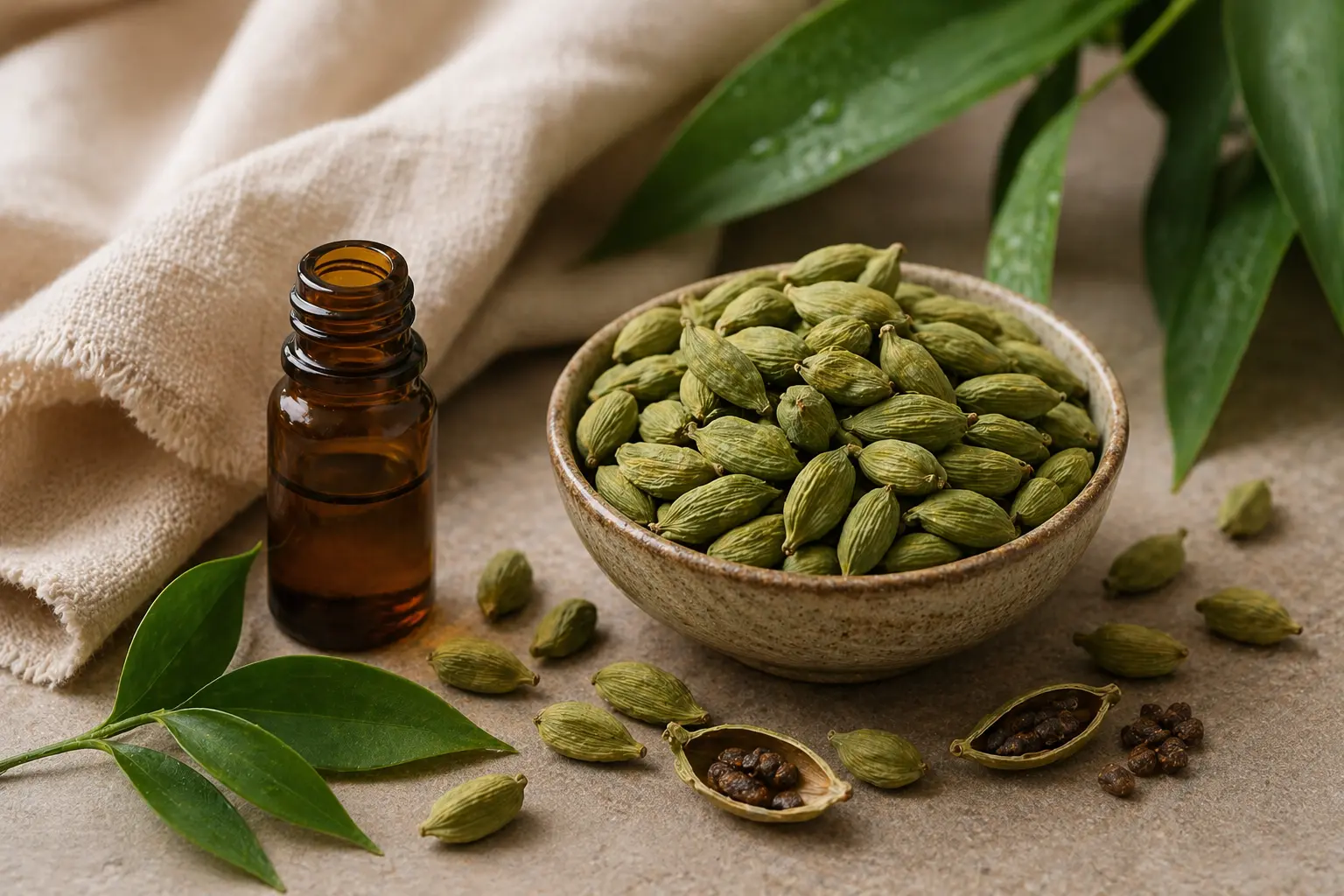
Cardamom essential oil is warm, sweet, spicy, and softly aromatic, with the elegant scent of green cardamom pods, citrus peel, fresh spice markets, and cozy kitchen rituals. Steam distilled from the seeds of Elettaria cardamomum, Cardamom essential oil is often used in diffuser blends, natural perfumery, massage oils at low dilution, and comforting home routines where a smooth spice note is wanted. It is gentler in aroma than many hot spice oils, but it is still a concentrated essential oil and should be diluted, diffused moderately, and used with care around sensitive people.
Further Reading and Sources
For a broader understanding of rosemary essential oil, botanical naming, chemistry, quality, and responsible aromatherapy practice, these resources are useful starting points:
- PMC: Evaluation of Marketed Rosemary Essential Oils
- SAGE: Systematic Evaluation of Rosemary Essential Oil in Aromatherapy Practice
- PubMed: Rosmarinus officinalis Review
- PMC: Rosmarinus officinalis Phytochemistry and Biological Activity Review
- PubChem: Rosemary Oil Safety and Hazards
This article is educational and does not replace medical advice. If you are pregnant, nursing, taking medication, managing a medical condition, preparing essential oil products for children or pets, or considering internal use, consult an appropriately qualified professional.