
What the Research Actually Says About Essential Oils and Sleep
Science
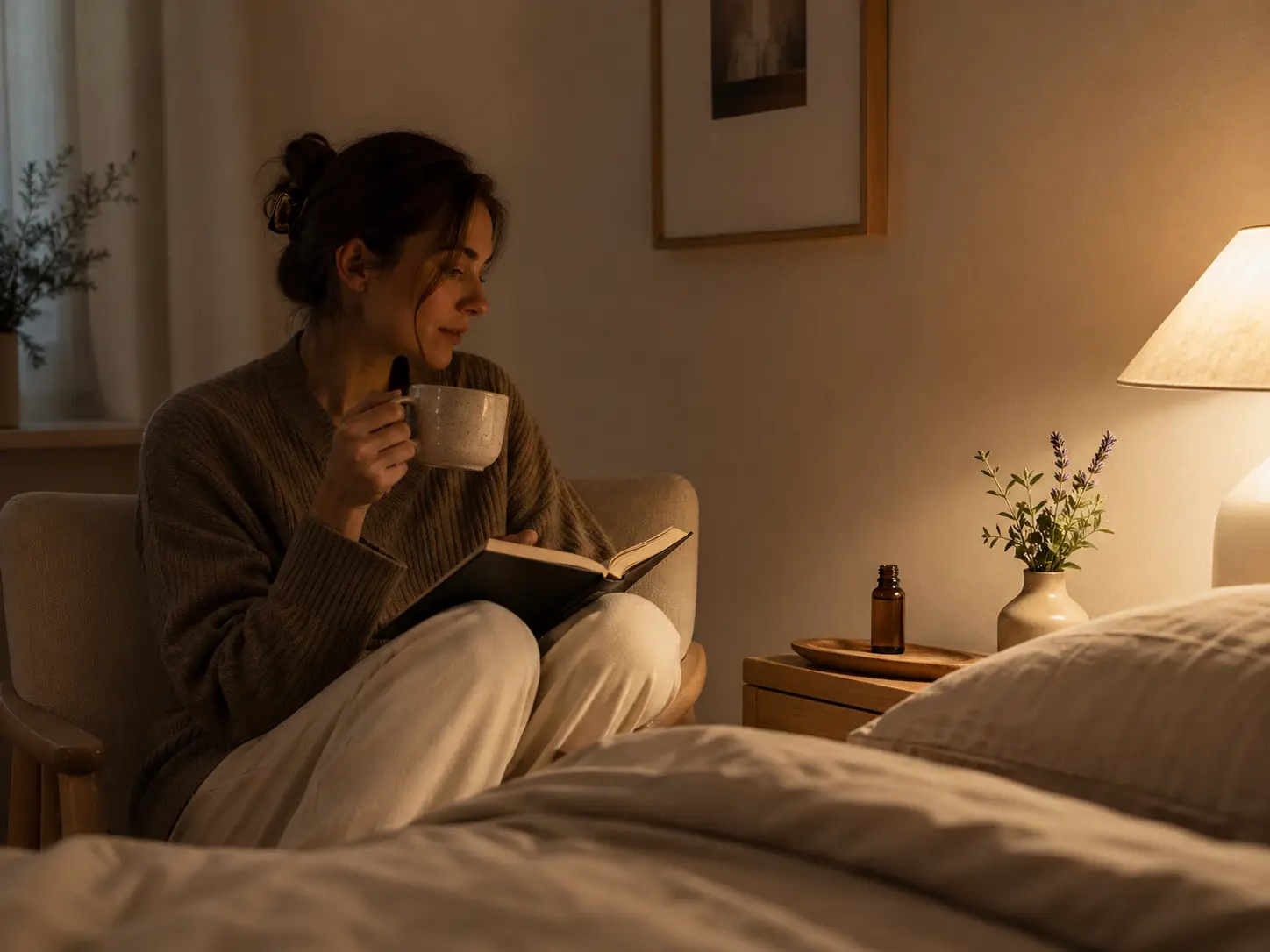
Sleep is one of the easiest places for essential oil claims to grow larger than the evidence. It makes intuitive sense that a softer scent, a quieter room, and a familiar evening ritual might help someone settle. Sometimes they do. But “may help with sleep” can mean many different things: falling asleep a little easier, feeling calmer before bed, sleeping slightly more comfortably, or reporting better sleep quality on a questionnaire. Those are related, but they are not the same outcome.
The most honest reading of the research is neither dismissive nor dreamy. There are enough positive signals to take the topic seriously, especially around inhaled lavender and mild sleep disturbance. But the literature is still narrower, more lavender-heavy, and more methodologically uneven than many wellness summaries imply. The right takeaway is not that essential oils are fake for sleep, and not that they are proven sleep solutions. It is that they may work best as modest, low-intensity supports inside a bigger bedtime environment.
Quick Answer
Research on essential oils and sleep suggests that inhalation may help some people with mild sleep difficulties, especially when the scent is calming, familiar, and used as part of a quiet evening routine. Lavender is by far the most studied oil, and recent reviews still suggest a meaningful but moderate signal rather than a dramatic one.
What the research does not prove is that essential oils reliably solve insomnia, replace medical care, or work equally well across all oils, ages, and sleep problems. They appear strongest as context-shaping tools that may improve wind-down quality and perceived sleep experience for some users, not as universal sleep treatment.
Why the Sleep Conversation Gets Simplified Too Fast
Sleep content often collapses everything into one promise: “this oil helps you sleep.” But sleep is not one thing. There is falling asleep, staying asleep, waking too early, feeling physically tense, feeling mentally noisy, having a room that never quite softens, and simply struggling to transition out of daytime alertness. Aromatic support may plausibly help with some of those layers more than others.
That distinction matters because an evening ritual can still be useful even if it does not fix the deepest sleep problem underneath. A scent that helps the bedroom feel less harsh may improve the runway into sleep without being a complete solution to chronic insomnia. That is not a failure. It is just a smaller, more realistic category of help.

What the Reviews Actually Suggest
Across systematic reviews and meta-analyses, the broad pattern is fairly consistent: inhaled aromatherapy, especially lavender-based use, may improve reported sleep quality for some adults. That does not mean every study is strong, every sample is large, or every result is cleanly transferable into ordinary home life. It does mean the topic has enough positive evidence to be more than pure lifestyle myth.
The more modern reviews still keep the same basic caution. The signal is there, but the evidence is concentrated around a small set of oils, with lavender doing most of the heavy lifting. Study designs vary. Participants vary. Outcome measures vary. Some studies are short. Some rely on self-report rather than richer sleep measurement. So the right phrase is “promising but bounded,” not “fully settled.”
What the Research Seems Strongest At
Mild sleep support
The evidence is more believable for modest improvement in sleep quality than for dramatic treatment-level change.
Lavender-led results
Most of the better-known positive findings cluster around lavender inhalation, not around every oil equally.
Routine context matters
Essential oils appear more convincing when they are part of a low-stimulation bedtime pattern rather than a random one-off test.
Why Lavender Dominates the Literature
Lavender shows up again and again because it is familiar, widely available, and culturally associated with calm. That alone does not prove it works, but it does explain why researchers keep studying it. It also means many people talking about “essential oils and sleep” are actually talking about one particular oil profile with one particular research footprint.
That matters if you are trying to generalize the findings too quickly. Evidence for lavender does not automatically transfer in full to every wood, resin, mint, floral, or citrus oil. Some scent directions may still help certain people rest more comfortably, but the literature is not evenly distributed. That is why a claim like “essential oils help with sleep” is always too broad unless it gets more specific.
What May Be Helping, Even When the Effect Is Real
If an evening aroma routine improves sleep for someone, the mechanism may not be one dramatic pharmacological answer. More often, it is probably a layered effect: the scent feels familiar, the room feels softer, the ritual cues the nervous system to slow down, the lights are lower, the person is doing the same thing at the same time each night, and the bedroom starts to become associated with winding down rather than remaining in full daytime mode.
That is one reason these routines can still matter even when the science is not miracle-level. Context is not fake. Environmental softening is not fake. Habit cues are not fake. But none of those things mean the oil itself should be marketed as if it carries the whole sleep result on its own.
What the Evidence Still Does Not Settle
The research does not prove that inhaled essential oils are reliable treatments for chronic insomnia, that they work equally across all populations, or that stronger scent gives better results. It also does not justify turning every bedtime problem into an oil problem. If someone’s sleep is being disrupted by pain, medication effects, untreated anxiety, sleep apnea, hormone shifts, or a chronically overstimulating routine, scent may still be supportive without being sufficient.
This is where many internet summaries become unhelpful. They move straight from “there are positive studies” to “use this oil to sleep better,” skipping over the size of the effect, the limitations of the studies, and the fact that a home diffuser cannot absorb every problem the sleep system is carrying.
Safety-first reminder: a bedroom routine works better when the scent stays light. All-night heavy diffusion, closed-room buildup, and strong blends can backfire, especially in people who are sensitive, headachy, pregnant, or already overstimulated.
What a More Useful Sleep Routine Looks Like
The most believable sleep routine is usually small. One familiar scent direction. One short period of use. Good ventilation. Low light. Less sensory clutter. A room that is actually set up for sleep rather than for aromatic performance. For many readers, that will work better than trying to build an intense “sleep blend” identity around bedtime.
That is why companion routines often matter more than the oil choice alone. Evening wind-down habits, lighter diffuser use, and awareness of when a room begins to feel too full all do more useful work than simply adding more drops. If you already know you are scent-sensitive, the practical lessons from smell sensitivity routines matter here too.
Which Oils Make the Most Sense to Mention Carefully
Lavender deserves the strongest mention because that is where the literature is most concentrated. Beyond that, some people build gentler bedtime routines around Roman chamomile, sweet marjoram, cedarwood, or softer floral-wood combinations. But those choices should still be framed as practical scent directions, not as universally proven sleep interventions.
The strongest sleep claim you can usually make with integrity is modest: this aroma may help a room feel quieter, may help the body recognize bedtime cues, and may support a smoother transition into sleep for some people. That is already enough to be useful.
The Best Interpretation Is Still the Middle One
The middle interpretation is the one worth keeping. Essential oils for sleep are not nonsense. They are also not magic. The research gives enough reason to respect lavender-led inhalation routines for mild sleep support, but not enough reason to talk as if a bottle replaces broader sleep care. The value is real when it stays proportionate.
That proportion is exactly what makes a routine sustainable. Once a scent is allowed to be a supporting element rather than the whole answer, it becomes much easier to use it well.

Science
What Is a GC/MS Test in Essential Oils?
A practical, plain-English guide to what GC/MS reports show, what they do not prove, and how to read them without overestimating what a lab sheet can tell you.

Science
Cold Pressed vs Steam Distilled Citrus Oils
Learn how extraction changes aroma, phototoxicity concerns, and practical home use when comparing cold pressed and steam distilled citrus essential oils.
Science
Why Oxidized Essential Oils Smell and Behave Differently
A plain-English guide to what oxidation does to essential oils over time, why aroma changes matter, and how storage habits shape how an oil smells and behaves later on.

Science
Migraine and Essential Oils: Why the Evidence Is More Mixed Than the Internet Suggests
A plain-English look at what migraine research on essential oils actually suggests, where the evidence is thin, and why a soothing ritual is not the same thing as a proven migraine treatment.
Further Reading and Sources
These review-level sources are the most useful starting points for the balanced framing in this article.
- A systematic review of the effect of inhaled essential oils on sleep
- A systematic literature review and meta-analysis of the clinical effects of aroma inhalation therapy on sleep problems
- The Sleep-Enhancing Effect of Lavender Essential Oil in Adults: A Systematic Review and Meta-Analysis
- A systematic review and meta-analysis of clinical trials on lavender for sleep disorders in older adults